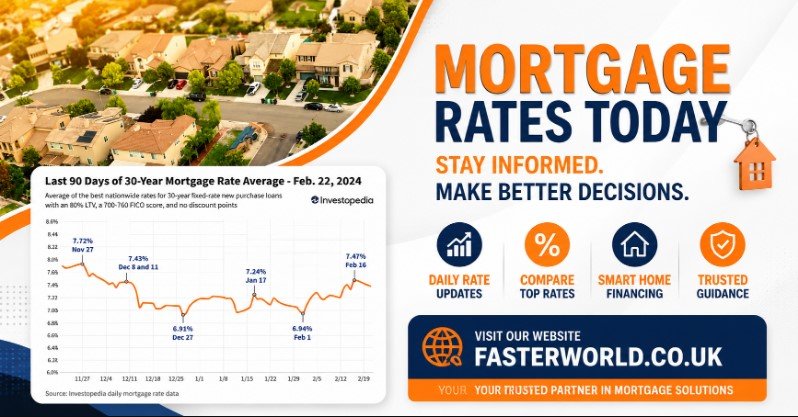
When interest rates change, many homeowners ask the same question: Is now the right time to refinance?
- What Are Refinance Mortgage Rates?
- How Are Refinance Rates Determined?
- Why Do Mortgage Rates Change?
- Should You Refinance Right Now?
- Fixed vs. Adjustable Refinance Loans
- How Much Can Refinancing Save?
- Understanding Closing Costs
- Tips for Getting a Better Refinance Offer
- Cash-Out vs. Rate-and-Term Refinance
- Common Mistakes to Avoid
- Questions to Ask Before Refinancing
- Conclusion
The answer depends on more than today’s advertised mortgage rates. Your credit score, home equity, loan type, debt-to-income ratio, and financial goals all influence whether refinancing will actually save money.
Understanding refinance mortgage rates today is the first step, but making a smart refinancing decision requires looking beyond the headline rate. This guide explains how refinance rates work, what affects them, when refinancing makes sense, and how to compare lenders confidently.
What Are Refinance Mortgage Rates?
A refinance mortgage rate is the interest rate offered when replacing your existing home loan with a new one.
Also Read: Mortgage Rates Today Comparison How to Find the Best Home Loan
Homeowners refinance for several reasons, including:
- Lowering their monthly payment
- Reducing the total interest paid
- Changing from an adjustable-rate mortgage (ARM) to a fixed-rate mortgage
- Shortening the loan term
- Accessing home equity through a cash-out refinance
Unlike rates for purchasing a home, refinance rates may differ slightly because lenders evaluate additional factors, including your existing mortgage and available home equity.
How Are Refinance Rates Determined?
Mortgage lenders don’t offer the same rate to every borrower.
Several factors influence the rate you may qualify for.
| Factor | Impact on Your Rate |
|---|---|
| Credit score | Higher scores usually qualify for lower rates. |
| Loan-to-value (LTV) ratio | More equity generally reduces lender risk. |
| Debt-to-income ratio | Lower monthly debt often improves eligibility. |
| Loan type | Conventional, FHA, VA, and jumbo loans have different pricing. |
| Loan term | Shorter terms often carry lower interest rates. |
| Market conditions | Inflation, Federal Reserve policy, and bond markets influence mortgage pricing. |
Even a small difference in interest rate can significantly affect the total cost of your loan over many years.
Why Do Mortgage Rates Change?
Mortgage rates move daily because they’re affected by broader economic conditions.
Common influences include:
- Inflation trends
- Employment data
- Treasury bond yields
- Housing market activity
- Investor demand for mortgage-backed securities
- Federal Reserve policy (indirectly)
Although the Federal Reserve does not directly set mortgage rates, its actions can influence borrowing costs across the economy.
Should You Refinance Right Now?
There isn’t a universal answer.
Refinancing may be worthwhile if it helps you meet a specific financial goal rather than simply chasing the lowest available rate.
You might consider refinancing if:
- Your new payment would comfortably fit your budget.
- You plan to stay in your home long enough to recover closing costs.
- Your credit score has improved since your original mortgage.
- You want more predictable monthly payments.
- \You need to consolidate higher-interest debt through a cash-out refinance.
On the other hand, refinancing may not make sense if closing costs outweigh your savings or if you expect to sell your home soon.
Fixed vs. Adjustable Refinance Loans
Fixed-Rate Refinance
A fixed-rate mortgage keeps the same interest rate throughout the loan.
Benefits include:
- Stable monthly payments
- Easier budgeting
- Protection from future rate increases
This option is popular among homeowners planning to stay in their homes for several years.
Adjustable-Rate Refinance (ARM)
An ARM usually starts with a lower introductory rate before adjusting periodically.
It may work well if:
- You expect to move within a few years.
- You anticipate paying off the mortgage early.
- You’re comfortable with possible payment changes later.
Borrowers should carefully understand adjustment caps and future payment risks before choosing an ARM.
How Much Can Refinancing Save?
Savings depend on several variables.
For example:
- Remaining loan balance
- New interest rate
- Loan term
- Closing costs
- Property taxes and insurance
A homeowner reducing their interest rate by even a fraction of a percentage point may save thousands over the life of the loan, but individual results vary.
Using a refinance calculator can help estimate your break-even point.
Understanding Closing Costs
Many borrowers focus only on interest rates while overlooking refinancing expenses.
Typical closing costs may include:
- Loan origination fees
- Appraisal fees
- Credit report fees
- Title services
- Recording fees
- Attorney fees (where applicable)
These costs often range between 2% and 5% of the loan amount, though actual costs vary by lender and location.
Some lenders advertise “no-closing-cost” refinancing, but those costs are often reflected through a higher interest rate or added to the loan balance.
Tips for Getting a Better Refinance Offer
Shopping around can make a meaningful difference.
Consider these strategies:
- Compare quotes from multiple lenders.
- Improve your credit score before applying.
- Reduce outstanding debt.
- Avoid opening new credit accounts during the application process.
- Verify all lender fees—not just the advertised rate.
- Consider buying discount points if you expect to keep the loan long term.
Getting several loan estimates within a short shopping window generally has less impact on your credit score than many borrowers assume.
Cash-Out vs. Rate-and-Term Refinance
Rate-and-Term Refinance
This option changes your interest rate, loan term, or both without significantly increasing your mortgage balance.
Best for:
- Lower monthly payments
- Paying off the loan faster
- Improving loan terms
Cash-Out Refinance
A cash-out refinance lets you borrow against your home’s equity.
Common uses include:
- Home improvements
- Debt consolidation
- Education expenses
- Major financial needs
Because you’re increasing your mortgage balance, it’s important to borrow carefully and understand the long-term cost.
Common Mistakes to Avoid
Many homeowners make refinancing decisions based only on advertised rates.
Avoid these common mistakes:
- Ignoring the annual percentage rate (APR)
- Failing to compare lender fees
- Extending the loan term without considering total interest
- Refinancing too frequently
- Skipping the break-even calculation
- Assuming every lender offers identical pricing
Taking time to compare complete loan estimates can help prevent costly surprises.
Questions to Ask Before Refinancing
Before signing a new mortgage, ask yourself:
- How long do I plan to stay in this home?
- What are the total closing costs?
- How long until I recover those costs?
- Is the payment affordable if my financial situation changes?
- Am I refinancing for savings, flexibility, or access to cash?
Clear answers to these questions can make the decision easier.
Conclusion
Understanding refinance mortgage rates today involves much more than checking a single number online. The best refinancing decision balances interest rates, fees, loan terms, and your long-term financial plans.
Rather than focusing only on the lowest advertised rate, compare complete loan offers from multiple lenders, calculate your break-even point, and consider how refinancing fits your overall goals. A thoughtful approach can help you reduce borrowing costs while avoiding unnecessary expenses.
FAQs
1. What affects refinance mortgage rates the most?
Credit score, home equity, loan type, debt-to-income ratio, loan term, and current market conditions all influence refinance rates.
2. How often do refinance rates change?
Mortgage refinance rates can change daily and sometimes multiple times within the same day as financial markets move.
3. Is refinancing worth it for a small rate reduction?
It depends on closing costs, loan balance, and how long you’ll keep the mortgage. A smaller reduction may still produce meaningful savings over time.
4. Can I refinance with less-than-perfect credit?
Yes. Many lenders offer refinancing options for a range of credit profiles, although stronger credit generally qualifies for better rates.
5. What’s the difference between APR and interest rate?
The interest rate reflects borrowing costs, while APR includes certain lender fees, making it a better comparison tool when evaluating loan offers.
For more updates visit: FASTER WORLD