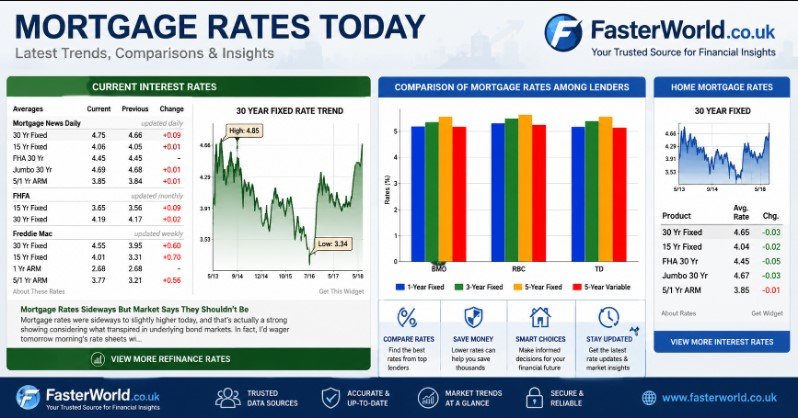
Buying a home is one of the biggest financial decisions most people will ever make. Even a small difference in mortgage rates can affect your monthly payment and the total amount of interest you pay over the life of the loan.
- Why Comparing Mortgage Rates Matters
- What Are Mortgage Rates?
- Fixed vs. Adjustable Mortgage Rates
- Factors That Affect Your Mortgage Rate
- Mortgage Rates Today Comparison: What to Look Beyond
- How to Compare Mortgage Offers Effectively
- Where to Compare Mortgage Rates
- Tips for Getting a Better Mortgage Rate
- Common Mistakes Buyers Make
- Should You Refinance When Rates Fall?
That’s why a mortgage rates today comparison is more than just checking who offers the lowest percentage. The best mortgage depends on your credit profile, loan type, down payment, fees, and long-term financial goals.
This guide explains how to compare mortgage rates, what influences them, and how to choose a loan that fits your budget with confidence.
Why Comparing Mortgage Rates Matters
Many buyers focus only on the advertised interest rate. While that’s important, it’s only one part of the total borrowing cost.
Also Read: Jelly Roll Net Worth How the Country-Rap Star Built His Fortune
A difference of just 0.5% on a 30-year mortgage can translate into thousands of dollars in additional interest over time.
Comparing offers helps you:
- Reduce monthly payments
- Lower total interest costs
- Find better loan terms
- Identify unnecessary lender fees
- Improve long-term affordability
Shopping around also gives you a stronger position when negotiating with lenders.
What Are Mortgage Rates?
A mortgage rate is the interest charged by a lender for borrowing money to purchase a home.
Your rate determines how much interest you’ll pay in addition to repaying the loan principal.
Mortgage rates change frequently based on:
- Economic conditions
- Inflation
- Central bank policy
- Bond market performance
- Housing market demand
- Individual borrower risk
Because rates can move daily—or even multiple times a day—it’s helpful to compare current offers before locking in a loan.
Fixed vs. Adjustable Mortgage Rates
Choosing the right loan starts with understanding the two main types.
| Feature | Fixed-Rate Mortgage | Adjustable-Rate Mortgage (ARM) |
|---|---|---|
| Interest rate | Stays the same | Changes after introductory period |
| Monthly payment | Predictable | May increase or decrease |
| Best for | Long-term homeowners | Short-term ownership or refinancing plans |
| Risk | Lower payment uncertainty | Higher future payment risk |
A fixed-rate mortgage offers stability, while an ARM may begin with a lower introductory rate but carries future uncertainty.
Factors That Affect Your Mortgage Rate
Lenders calculate rates based on several financial factors.
Credit Score
Borrowers with higher credit scores often qualify for better interest rates.
Improving your score before applying could help lower borrowing costs.
Down Payment
Larger down payments generally reduce lender risk.
Putting down 20% or more may also eliminate private mortgage insurance (PMI) on many conventional loans.
Loan Type
Different loan programs have different pricing.
Common options include:
- Conventional loans
- FHA loans
- VA loans
- USDA loans
- Jumbo loans
Each has different eligibility requirements and interest rate structures.
Loan Term
Shorter loans usually carry lower interest rates but higher monthly payments.
Typical options include:
- 15-year mortgage
- 20-year mortgage
- 30-year mortgage
Debt-to-Income Ratio (DTI)
Your monthly debt obligations compared to income influence lender risk assessments.
Lower DTI often improves approval chances.
Mortgage Rates Today Comparison: What to Look Beyond
Many borrowers compare only the interest rate, but that’s not enough.
Pay attention to these factors as well.
Annual Percentage Rate (APR)
APR includes both the interest rate and many lender fees.
It provides a better picture of the total borrowing cost.
Closing Costs
Typical closing costs may include:
- Loan origination fees
- Appraisal
- Title insurance
- Credit report
- Recording fees
- Attorney fees (where applicable)
Sometimes a slightly higher interest rate comes with significantly lower upfront costs.
Discount Points
Lenders may allow borrowers to purchase discount points to reduce the interest rate.
This strategy can make sense if you expect to stay in the home for many years.
Rate Lock Period
Mortgage rates change frequently.
A rate lock protects your quoted rate for a specified period while your loan closes.
How to Compare Mortgage Offers Effectively
Instead of choosing the first lender you find, compare multiple offers using the same loan details.
Comparison Checklist
| Item | Why It Matters |
|---|---|
| Interest rate | Monthly payment |
| APR | Overall borrowing cost |
| Closing costs | Upfront expenses |
| Loan term | Total interest paid |
| Monthly payment | Budget planning |
| PMI requirements | Extra monthly costs |
| Prepayment penalties | Future flexibility |
| Rate lock period | Protection from market changes |
Requesting standardized loan estimates makes comparisons easier.
Where to Compare Mortgage Rates
You have several options when shopping for a home loan.
Banks
Traditional banks often offer competitive products for existing customers.
Credit Unions
Credit unions sometimes provide attractive rates and lower fees for members.
Mortgage Brokers
Brokers compare multiple lenders on your behalf.
Online Mortgage Lenders
Digital lenders often streamline applications and may offer competitive pricing.
Whichever option you choose, compare at least three to five loan offers whenever possible.
Tips for Getting a Better Mortgage Rate
Improving your financial profile before applying can make a noticeable difference.
Consider these strategies:
- Improve your credit score
- Reduce outstanding debt
- Increase your down payment
- Avoid opening new credit accounts before closing
- Compare multiple lenders
- Lock your rate at the right time if available
- Maintain stable employment and income documentation
Small improvements may lead to better loan offers.
Common Mistakes Buyers Make
Many first-time buyers unintentionally increase their borrowing costs.
Avoid these common mistakes:
- Comparing only advertised rates
- Ignoring lender fees
- Focusing only on monthly payments
- Applying with only one lender
- Forgetting to compare APR
- Waiting too long to secure a favorable rate
- Taking on new debt before closing
Careful preparation can prevent expensive surprises.
Should You Refinance When Rates Fall?
If mortgage rates decline after you’ve purchased a home, refinancing could reduce your payment or shorten your loan term.
Refinancing may make sense when:
- Interest savings exceed refinancing costs
- Your credit score has improved
- Home equity has increased
- You want to switch loan types
- You plan to stay in the home long enough to recover closing costs
Always calculate the break-even point before refinancing.
FAQs
How often do mortgage rates change?
Mortgage rates can change daily and sometimes multiple times during a single business day depending on financial markets.
Is the lowest mortgage rate always the best choice?
Not necessarily. A loan with a slightly higher interest rate but lower fees may cost less overall. Compare both the interest rate and the APR.
What credit score helps qualify for better mortgage rates?
Requirements vary by lender and loan program, but stronger credit profiles generally receive more favorable pricing.
Should I compare mortgage rates with multiple lenders?
Yes. Comparing several lenders can reveal meaningful differences in rates, fees, and loan terms that may save money over time.
What is a mortgage rate lock?
A rate lock is an agreement that protects your quoted interest rate for a specified period while your mortgage application is completed.
Does a larger down payment reduce mortgage rates?
A larger down payment can lower lender risk and may help borrowers qualify for more competitive rates, depending on the lender and loan program.
For more updates visit: FASTER WORLD