In the competitive landscape of Australian higher education, the pressure to perform often transcends simple “study stress,” evolving into a significant mental health challenge. According to the 2024 Uni Student Wellbeing Survey, nearly 42.8% of Australian university students experience significant mental health or wellbeing difficulties, with academic workload cited as a primary stressor.
The weight of a 5,000-word research paper or a complex thesis can feel like navigating a storm without a compass. This is where Structural Writing Frameworks act as a vital intervention. By breaking down the nebulous task of “writing” into a series of logical, manageable architectural steps, these frameworks don’t just improve grades—they actively reduce the cortisol-inducing uncertainty of the blank page.
The Psychological Architecture of Writing
For many students in Sydney, Melbourne, and Brisbane, the “blank page syndrome” isn’t a lack of ideas but a lack of order. Structural frameworks, such as the IMRaD (Introduction, Methods, Results, and Discussion) model or the SRSD (Self-Regulated Strategy Development) approach, provide a “writing toolkit.” This cognitive scaffolding allows the brain to switch from “panic mode” to “problem-solving mode.”
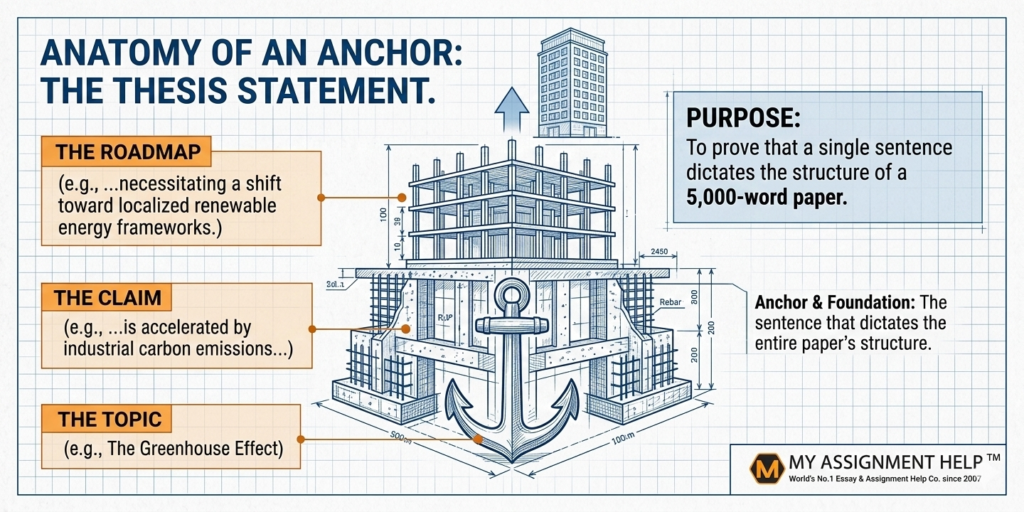
When you have clear guidance on writing a thesis statement, the rest of the document gains a natural gravity. The thesis becomes the “North Star” of your assignment, ensuring that every subsequent paragraph serves a defined purpose. This structural clarity prevents the common “mid-essay collapse,” where a writer loses the thread of their argument—a major source of late-night academic anxiety.
Data-Driven Insights: Why Structure Matters
Research indicates that students who utilise evidence-based writing frames see a marked increase in self-efficacy. A 2025 study on Australian international students highlighted that cultural and language barriers exacerbate writing stress, yet structured “writing frames” (skeleton outlines with sentence starters) reduced task-completion time by up to 30%.
| Framework Type | Key Benefit | Impact on Stress |
| IMRaD | Standardises scientific reporting | Reduces “what comes next” anxiety |
| TEEL/PEEL | Ensures paragraph-level cohesion | Prevents “wandering” arguments |
| The 3-Part Essay | Simplifies complex narratives | Makes large word counts manageable |
By applying these frameworks, students can move away from “marathon writing sessions”—which the Australian University Mental Health Framework identifies as a risk factor for burnout—and toward “modular writing.”
Case Study: Connecting Global Issues to Local Structure
Consider the challenge of writing about complex environmental topics, such as the greenhouse effect. Without a framework, a student might struggle to balance the chemistry of CO2, the politics of the Kyoto Protocol, and the local impact on the Great Barrier Reef.
However, using a Discussion Frame, the student can compartmentalise:
- The Mechanism: (The science of heat trapping)
- The Impact: (Environmental consequences)
- The Solution: (Mitigation strategies)
This “siloing” of information ensures the writer is never overwhelmed by the sheer scale of the topic.
Key Takeaways for Stress-Free Writing
- Start with the Blueprint: Never write the first word of your draft without a 1:10 ratio outline (e.g., 10 bullet points for a 1,000-word essay).
- The Thesis is Your Anchor: A strong thesis statement eliminates 50% of unnecessary research by defining exactly what you don’t need to include.
- Modular Drafting: Write the “easiest” sections first (often the Methods or Body paragraphs) to build momentum and reduce the “entry barrier” stress.
- Referencing as You Go: Avoid the “2 a.m. citation hunt” by using a structural framework that includes a bibliography placeholder for every claim made.
FAQ: Navigating Academic Pressure
Q: Can a framework really help if I don’t understand the topic?
A: Actually, yes. Frameworks like the “Explanation Frame” force you to identify the gaps in your knowledge. If you can’t fill a “Causal Link” box in your outline, you know exactly what you need to research next, preventing aimless scrolling.
Q: Is using a framework considered “cheating” or “AI-style” writing?
A: Not at all. Structural frameworks are the “gold standard” of traditional academic training. They are endorsed by Australian universities as a way to demonstrate critical thinking and logical flow—the exact opposite of the generic, often repetitive output of basic AI tools.
Q: How do I handle a 10,000-word dissertation without burning out?
A: Use “Micro-Frameworks.” Don’t look at it as one 10,000-word monster. Look at it as ten 1,000-word modules. Completing one module provides a “dopamine hit” that sustains you for the next, keeping stress levels baseline.
About the Author: Dr. Helena Richardson
Senior Academic Consultant at MyAssignmentHelp
Dr. Helena Richardson holds a PhD in Educational Psychology from the University of Queensland. With over 15 years of experience in the Australian tertiary sector, she specialises in developing cognitive writing strategies that assist students in overcoming academic anxiety. Her work focuses on the intersection of structural linguistics and student mental health, helping thousands of learners achieve Distinction-level results without compromising their wellbeing.
References:
- Uni Student Wellbeing Survey – Summary Report 2024. Universities Australia.
- Australian University Mental Health Framework. Orygen (2025 update).
- Harris, K. R., & Graham, S. (2024). Self-Regulated Strategy Development in Australia: Impact on Writing and Resilience.